On the third day a wedding took place at Cana in Galilee. Jesus’ mother was there, and Jesus and his disciples had also been invited to the wedding. John 2:1-2
Today is my birthday! I’m not embarrassed to say I have reached the ripe age of 57 because, to be honest, it’s with the grace of God I’ve made it this far. I love birthdays, Christmas, Thanksgiving, 4th of July, Valentines’ Day, baby showers, you name it. If it’s a celebration I’m in.
Maybe it’s that my fellow celebrators have decided, like me, to take a few hours off from the trials and tribulations of the world. For our annual celebrations, it’s also a way of thanking God we’ve made it through another year with His grace and provision.
God certainly made us a people intended to celebrate. In the Old Testament there are seven major festivals for the chosen people to celebrate. That didn’t even include weddings and births. On top of that, the Sabbath, was in effect, a weekly celebration to take time and honor God.
For as a young man marries a young woman, so shall your sons marry you, and as the bridegroom rejoices over the bride, so shall your God rejoice over you. Isaiah 62:5
If you’ve never watched the show, The Chosen, you should definitely check it out. There are so many great episodes but one of my favorites is the famous wedding in Cana. To watch what Jesus would have been like at such a blessed time and see his disciples join the celebration really brought home the human side of Jesus.
It’s unfortunate there are Christian sects who consider celebrations sinful. They certainly haven’t read the same Bible I have which as we progressed through the events of the New Testament, we were given the opportunity celebrate our Lord’s birth, Easter, Pentecost, and baptism.
Today I will rejoice that God took good care of me this last year. I will celebrate in the knowledge that He is good and considers me one of His own. And I will thank Him that He is a God who loves to celebrate with His people the joys of life.
…for it is God who works in you to will and to act in order to fulfill his good purpose.Philippians 2:13
How glorious would it have been to live when Jesus was physically here on Earth? To sit at the Sermon on the Mount and hear His words directly from His mouth? To be in a busy marketplace and bump into Him – turning to see directly into His face? Isn’t it amazing how He spent so little time here with us yet the impact has been so astounding that even our days are marked by when He arrived? And when He ascended, the gift He left behind is something for which we can never be thankful enough.
“If you love me, keep my commands. 16 And I will ask the Father, and he will give you another advocate to help you and be with you forever—17 the Spirit of truth. The world cannot accept him, because it neither sees him nor knows him. But you know him, for he lives with you and will be in you.John 14: 15-17
When you study the Bible you see how Jesus and the Holy Spirit touched lives even before the time we say God became fully human. Their presence is woven throughout the Old Testament. So it’s not as though they were created suddenly. God, Jesus and the Holy Spirit all spoke the world into creation and have placed their holy hands on our lives throughout history.
So, today specifically I praise God for the gift of the Holy Spirit and for being our constant intercessor, our inner voice, our God whisperer.
It is the Holy Spirit that helps us to pray when we don’t know what to pray – because the situation has gotten so dire. It is the Holy Spirit who whispers to us to get up and do God’s work. It is the Holy Spirit who partners with us when we need rescue.
In the same way, the Spirit helps us in our weakness. We do not know what we ought to pray for, but the Spirit himself intercedes for us through wordless groans.Romans 8:26
I shared with my BSGs in the past that when I’m really stressed or worried I have a difficult time praying. My mind is so jumbled and full of negative thoughts I can’t seem to quiet it down. One of my BSGs responded saying, “I’ve just cried out, “help me!” when I don’t know what to say.” That’s great advice. It says it right there in Romans 8. The Holy Spirit will help us pray. Will give us the words to speak to God.
Friends, God is so beautiful and loving that He didn’t leave us orphans. He didn’t leave us grieving because He left us with a piece of Him inside of each of us. I once heard a Christian teacher say that we don’t need to attain patience, kindness, love, etc. We already have all those imputed through the Holy Spirit that lives in us because we believe. We just need to ask the Holy Spirit to help us release those gifts. To help us pray the words to fight back against the devil. To whisper to us “love this person right now.”
We need to believe that God has given us the access to this awesome power. And once we do that, we should pray to unleash it with all its glorious might.
Once, on being asked by the Pharisees when the kingdom of God would come, Jesus replied, “The coming of the kingdom of God is not something that can be observed, 21 nor will people say, ‘Here it is,’ or ‘There it is,’ because the kingdom of God is in your midst.”Luke 17:20-21
My BSGs are embarking on a new study called, “He Speaks to Me,” by Priscilla Shirer. What stood out to me in the first video we watched was her discussion about the Kingdom of God. She shared with the audience about how in the Old Testament the Israelites prayed for the “coming” Kingdom of God. It was something they hoped and yearned for throughout their years as a new and developing nation. And right at the beginning of the New Testament we find John the Baptist proclaiming:
“Repent for the kingdom of heaven has come near!”Matthew 3:2
With Jesus’ arrival, the Kingdom of God (or Heaven) became flesh and was brought to the Israelites. And so many of them refused to grasp that their prayers were answered. And when Jesus was resurrected, the Holy Spirit remained to cover us with the Kingdom.
Today I praise God for His continual presence in our world, in my life and yours. The big word is “omnipresent.” But I like to think of it more as though I move through and live in God’s presence. He’s not “with me.” I am more like the tiny seed that is buried in a fluff of freshly picked cotton. I am in God’s kingdom, surrounded by Him.
When I grasped this idea just a year or so ago it changed my perspective dramatically. I don’t need to ask God to come help me or be near me. I just need to slow down my brain and remember I am always in His presence. We are all in His presence, whether we believe in Him or not.
It reminds me of the movie, The Matrix. There are those in the movie whose brains and bodies are hooked up to a virtual reality machine. They move about in a phony world without realizing its fake character. And then there are the people who have disconnected from the computer and live almost in an alternate space – the real, tangible world. When we disconnect from the world of the flesh and recognize that this is God’s world, His created space, and that we are in His midst, we start seeing life and how to live it from a new perspective.
The Kingdom, Jesus reiterated in our first verse is not a specific “thing” to be seen. It’s because it is everything in God’s creation. It is the grace God gifted us through Jesus. It is His Holy workings in our lives via the Holy Spirit. The kingdom is God and God is the kingdom. Gnaw on that a bit!
When I’m struggling with an issue or feel pulled apart by the fleshly world, I now seek that “sweet spot.” That quiet moment where I can feel nestled in His presence, like that little cotton seed. I wrap it around me like a warm, soft blanket and thank God I can call him “home.”
For I command you today to love the Lord your God, to walk in obedience to him, and to keep his commands, decrees and laws; then you will live and increase, and the Lord your God will bless you in the land you are entering to possess.Deuteronomy 30:16
I grew up not wanting to have children. In my isolated world I experienced a parenting style that used harsh, physical, anger-fueled discipline. I didn’t know there was any other way and knew it wasn’t what I wanted impose on any children. So often as we become our own people, cleaved from our parents, we take the elements of parenting we don’t like and try to do the exact opposite. However, I also acknowledged as a new adult that the harsh discipline kept me from a lot of dangerous behavior. So where was the balance?
If you take a brief walk through the history of parenting you’ll see a modern conflict similar to the one I was having. The harsh disciplinary view of old was met face on with Dr. Spock and his more “loosey goosey” style. But as the Spock kids became the radical children of the 60s and 70s parents searched for a middle ground. One psychologist, Dr. James Dobson took up the challenge. He brought parents back into the position of authority but done with love.
Discipline isn’t, by definition, a bad thing. Studies have shown that the most effective way to foster healthy relationships with children and give them the ability to learn and utilize self-control is through positive discipline.
Lauren Steele, Fatherly.com
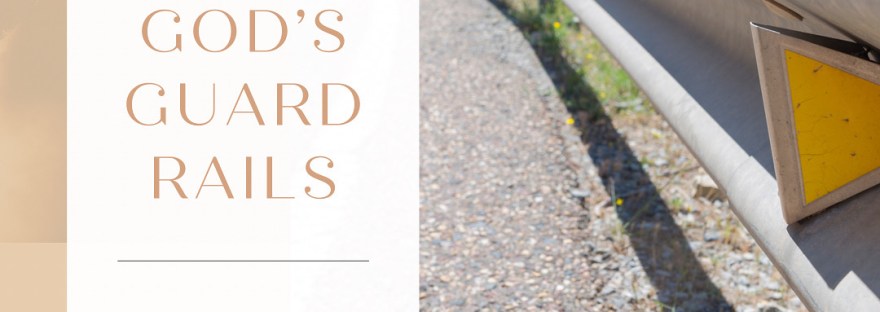
We humans need fatherly guardrails. It’s a proven fact since the beginning of time. We need to remember that when Moses came down the mountain with the 10 commandments they were NEW rules. New guardrails of how to worship God, how to treat other people, how to be respectful within our families, and how to protect ourselves from well, ourselves.
The Old Testament has a shadow story woven throughout. Yes, we follow the woeful Israelites through trials, tribulations and successes. But put in context God is constantly showing them how to live differently than all the other nations around them. Nations that He created as well but saw how they overwhelmingly desired to live outside His guardrails – rampant sexual exploits, child sacrifice and more. He was testing them all, just like today. Free self-reign or accepting governance by God.
I praise God today for His guardrails. For the 10 Commandments He gave us to live within. Because just like our children we prove over and over that without them we can get ourselves into a lot of trouble. Without His guidance, His narrow path, we wander off into parts unknown, get lost, live in fear and despair, and ruin not just our lives but the ones we love.
When I met my husband and told him why I didn’t want children he assured me we’d figure it out. He wouldn’t let my past keep me from a full future. Thankfully as we took the journey, we met God along the way. I may have pushed up against those guardrails a few times but He always calls me back to the center of the road.
After three days they found him in the temple courts, sitting among the teachers, listening to them and asking them questions. Luke 2:46
“The teacher encourages the student morphs – moth to beauteous butterfly soars”
Mala Naidoo, author
When God directed me to start the Emboldened blog He also led me to a few simple quotes to put on the homepage. I didn’t know at the time one day I’d be using those quotes for this week’s study on Jesus and His teaching nature! Of the few quotes He led me to, I included this one by Joyce Meyer:
“If you leave church and are not convicted, asking questions, or emboldened then either you are at the wrong church or you weren’t paying attention.”
Joyce Meyer
How many times have you left church and within an hour couldn’t remember what the sermon was about? You couldn’t even pull up the general topic in your memory?
I recently heard someone say that we don’t go to church to sit and put in our “dues” to God. It’s where we should 1) be rejuvenated for the mission and 2) get more training for the mission. And the second we leave the doors of our “God classroom” we should be at the ready to embark on the commission which Jesus gave us in Matthew 28:19. When church becomes a place where we leave just feeling like that was a “nice” experience, at best, or an obligation, at worst, we owe it to our personal faith progression to re-evaluate the situation.
When I started going to church my family ended up at a large Presbyterian church nearby. The pastor was just what I needed at the time. He was more counselor than teacher. And when I left each Sunday I felt he had really spoken to the problems I was having and reminded me that God loved me. The sermons were light on scripture, maybe one or two mentioned, and heavy on personal stories. But I soon found that sole message to be not quite enough. I wanted to know more. And the “teaching” sermons were what I gobbled up. As my husband can attest, I’m very curious. He constantly reminds me that I like to ask questions that seem to have no answers.
As a developing Christian, we should all be asking questions about God. If this “almighty being” is to be the center of our universe, the touchstone for how we live our lives, and the message we herald, shouldn’t we know everything we can know so we are prepared when sin enters our sphere? So we can be prepared when a seeking, fellow man starts asking us questions?
From learner to teacher. That’s exactly the path Jesus took. Here’s the rest of the scene when Jesus’ parents found him, as a boy, in the temple courts.
"Everyone who heard him was amazed at his understanding and his answers." Luke 2:47
And so, I constantly seek to learn more about this awesome God. At the beginning of this year my husband and I were directed to a new church. My son-in-law and his friend host a Christian men’s podcast called “Supplement the Faith.” They heard on a local St. Louis radio station a show called “Core Christianity.” The main host is Pastor Adriel Sanchez, who unbeknownst to me at the time, is a pastor in my town. They raved about his sound, Christian doctrine and told us we had to go check him out.
And so we went. The music was not my favorite – very simple and traditional hymns. The style of service was more formal than I was used to. But when Pastor Adriel gave his sermon I realized I was listening to a teaching pastor. That day, my church “program” was scribbled all over with notes!
In a brief period of time, I’ve learned a lot from and about Pastor Adriel. He and his beautiful wife have four little children with another on the way. This young pastor, who has led his fairly recently planted church for only about seven years, can be heard on the radio and podcast throughout the world via Core Christianity – which is a question and answer format. His youthfulness stands in contrast to his calm, confident poise. I recently asked Pastor Adriel if he’d be willing, in his busy schedule, to talk about his pastoral style.
And if you are on your faith journey toward learning more about His Word, I encourage you to tune in to either Pastor Adriel’s sermons at North Park Presbyterian (PCA) or the Core Christianity podcast. The questions asked on the podcast might just be something you get asked one day!
Kris: You seem to be drawn toward being more of a “teaching” type pastor than say a “counselor” type. How do you think you developed that style?
Pastor Adriel: I have a firm conviction that from the pulpit my job is to communicate God’s word clearly, and seek to apply it to the folks that God has entrusted to my care. Teaching or explaining the Bible is really important to me because I know that God’s word is the source of life. I do seek to provide biblical wisdom or counsel at times – but often that happens in the context of one on one conversations within the church.
K: Who are your favorite Christian authors/pastors?
PA: I love reading the Christian classics. St. Augustine’s Confessions, Martin Luther’s Commentary on Galatians, Calvin’s Institutes, C.S. Lewis’ Mere Christianity. I nerd out on church history, so I really enjoy reading the early church fathers. As far as living authors are concerned, I like books by theologians like Michael Horton, and pastors like Tim Keller.
K: What got you involved in doing Core Christianity and the podcast?
PA: One of my seminary professors invited me to be on a podcast he had hosted for decades called the White Horse Inn. Over time, we started thinking about a new project that would reach a broader audience helping them to understand the core doctrines of Christianity. A lot of research has come out recently highlighting how little Christians know about their faith – so this was a huge need. Our goal has been to answer basic listener questions about the Bible and the Christian life, and in the process to point folks to Jesus and his gospel. As we grow in our understanding of God’s word, we’re enabled to love and serve God better.
K: What do you like most about doing the podcast?
PA: I love the live element. I think it makes the show exciting, because we can’t really anticipate what kind of call we’re going to get. As a pastor, I also love it when I’m able to answer a question for someone and I can tell audibly that they’re encouraged by God’s word.
K: What are the most frequent topics you get asked?
PA: Questions related to marriage, assurance of salvation, finding a good church, and how to properly apply God’s law are common from our audience. Depending on what’s going on in our broader society, we also will get questions on current events.
K: What question have you gotten that “stumped” you? And what was the funniest question?
PA: Never been stumped! Just kidding. Actually, sometimes we get very obscure Bible questions, or questions for which there is no clear biblical answer. I find those questions to be the most difficult to handle. As far as the funniest question we’ve received… not long ago someone asked if there were fish on the ark too. That one made me chuckle.
K: Which book of the Bible do you enjoy teaching the most and why?
PA: I find that whichever book I am preaching through tends to become my favorite book for that season. Believe it or not, I had a ton of fun preaching through Leviticus a couple of years back. I also really enjoy preaching through the Gospels. I preached through Mark early in my ministry, and like to revisit the Gospels from time to time in-between other books.
K: Which book seems to be the most misunderstood?
PA: As I field questions about the Bible, I think one book that’s frequently misunderstood is Galatians. Many believers don’t have a proper understanding of the distinction between the law, and the gospel, and they struggle to understand how God’s law (and various OT commandments) are to be applied today. Galatians is helpful because it speaks to this kind of problem.
K: Do you see value in studying the entire Bible — not just the New Testament — and why?
PA: Absolutely. Jesus said in John 5 that Moses wrote of him, and in Luke 24 that the entire Bible was about him. The entire Bible gives us a glorious picture of redemptive history, and each story in that history is meant to instruct us in one way or another (1 Cor. 10:11). If you don’t study the Old Testament, you’ll miss out on so many of the riches in the New Testament, and you’ll miss out on Jesus as he’s revealed in the types and shadows of the Old Covenant.
K: What are your overall personal goals as a pastor for say the next 5 years? 10 years?
PA: Honestly, I just want to be a good husband, a good dad, and a faithful pastor. My goal is to grow in that for the next 5-10 years.
Thank you to Pastor Adriel for his time! Whether it be through a teaching pastor, Bible study groups/individual, Christian authors, a radio show or Christian podcast, these days we have so many resources at our fingertips to get to know God. As Christians, we must make it a priority to place this knowledge of His ways firmly at the forefront of our lives.
I wanted to leave you today with this quote about being a learning and then teaching Christian:
He who asks will have; what more did he ask for? But he who seeks will go further; he will find, will enjoy, will grasp, and will know that he has obtained. He who knocks will go further still, for he will understand, and to him will the precious thing be opened. He will not merely have the blessing and enjoy it, but he will comprehend it.
And hope does not put us to shame,
because God’s love has been poured
out into our hearts through the Holy
Spirit, who has been given to us.Romans 5:5
In February of 2020, my beloved mother in law got some disturbing news. She possibly had uterine cancer. We all started praying and hoping for negative tests. But with each test, each imaging, we were disappointed. Our hopes for it being “just a thing” were dashed.
In my prayers I lifted her up to God as one of His very faithful daughters. And when the bad news came, I cried out to Him. It wasn’t fair. I couldn’t see why He would allow this to happen.
And as quickly as I cried out, He answered me. “I have a plan. You need to trust in me.” So, I rested my hope in patience and faith and the knowledge that God has been there for her in the past.
Such hope as is the fruit of faith, patience, and experience, namely, the full assurance of hope;
Benson Commentary on Romans 5:5
When I read the verse from today, I wondered about the word, “shame.” The clarification I found was that Christian hope will not disappoint or be deceptive. God has proven Himself over and over of His faithfulness. The apostle Paul, in his letter to the Jews and Christians in Rome, reminds us that even before we were willing to worship God fully He sent His son to die for us. Think about that. We didn’t have to prove ourselves to Him first.
You see, at just the right time, when
we were still powerless, Christ died
for the ungodly. Very rarely will anyone
die for a righteous person, though for a
good person someone might possibly dare
to die. But God demonstrates his own love
for us in this: While we were still sinners,
Christ died for us.Romans 5:6-8
He goes on to say if God would do this for us, how much more can we expect? How much more hope can we put in the fact that God will take care of us?
As a maturing Christian this idea of “hope” has gone through a transition in my thinking. And where I started mirrors what so many non-believers struggle with when looking at Jesus followers. “If I pray and hope that someone is cured and they aren’t, doesn’t that mean God’s not listening (or doesn’t care or maybe the person doesn’t deserve it?).” But friends, God’s plans are so beyond our own!
I truly believe that God allows us to experience trials so that we can change our perspective of what living a “good life” in the world means. We, through our experiences, can offer hope to others that they can come out the other side with renewed faith. And He uses people around us to show His love during difficult times.
Every single apostle, every single lover of God in the Old Testament went through extremely difficult times. It was their hope they placed in Him that sustained them. And it was their experiences that help us to remember He loves us.
As for my mother in law? Praise God that through surgery and chemotherapy her cancer was eradicated. But the message I got from God was that even if she succumbed to cancer, He still had her safely in His arms. Because that is the greatest message of hope that Jesus gave us. We are saved from wrath. We are saved from the sins of this world. And we will find a loving home for us waiting at the end.
Let us hold unswervingly to the hope we
profess, for he who promised is faithful.Hebrews 10:23
We sing songs about God being our Rock. We hear sermons about not living as though on shifting sand. And yet so often I find myself having days where my faith feels more like something I’ve placed in a box to access at a later date and time. I rush about “doing life,” not as a Christian but as a citizen of the world. I let go of my Rock and hold on to my to do list.
But what do we, as Christians, really want to accomplish in our lives? If it’s simply completing to-do lists every day, we miss out on some of the greatest human qualities God gifted us – the ability to dream and grow and have hope.
When I was in high school, I wanted to be an astronaut. I met with Air Force recruiters who were enthusiastic about me joining up. But when I sat down with my parents, they immediately discouraged me. They thought I couldn’t handle the rigor and discipline of training. I had two choices – to ignore them and join anyway or give up my dream. Had I a strong prayer life, I could’ve lifted up this quandary to God. And then be guided by Him. At each roadblock I could’ve held fast to the knowledge that He put me on that path. But I’m sorry to say, I neither prayed nor kept my dream alive.
This verse today harkens back to Abraham and Sarah’s unswerving faith in God. They went through terrible trials in which it would’ve been understandable had they given up on God’s promises. We see throughout the Old Testament when the Israelites did give up hope. They grumbled to Moses and set off in directions which brought death. And who can forget Lot’s wife – looking backward rather than forward to God’ promise?
How often do we pray for help from Jesus, knowing that He answers prayers, and then after things get a bit tough or we feel the wait is too long we give up on our hopes and dreams?
Blessed is the one who perseveres under
trial because, having stood the test,
that person will receive the crown of
life that the Lord has promised to those
who love him.
James 1:12
God never breaks a promise. It’s always us. It’s us that needs to take our faith out of the box and place it at the top of our list each day. We need to hold fast to the knowledge that God is working for us and not against us. Whenever we are tempted to give up or get discouraged about our dreams, we need seize the promises that God has shown us.
Here’s a prayer from Sparkling Gems from the Greek that might help you, through faith, “hold unswervingly” to your dreams!
Lord, I am well aware that events will occur in life that will tempt me to release the dream You put in my heart. So right now, I ask You to fill me with the courage I need to refuse to let go of my dream. Even though my mind and the circumstances around me may send signals that the dream will never come to pass, I know that You are faithful to what you have promised. Help me wrap my arms of faith around your promises and never let go until I see them come into manifestation! I pray this in Jesus’ name!
Lesson #10: Make Jesus the King of every aspect of your life, especially the parts you grasp tight control over.
“The pride of your heart has deceived
you, you who live in the clefts of the
rocks and make your home on the heights,
you who say to yourself, “Who can bring
me down to the ground?”
Obadiah 1:3
My BSGs (Bible Study Girls) now know each others’ longstanding mini-kingdoms that we like to control. When we are asked questions in various studies about our sins we laugh and say, “Oh, I can answer that for you!” This is why I love these ladies. We have opened our lives to each other in trust. And, we expect to be held accountable for growth in our troublesome areas. I, for one, had an epiphany a month ago about one of my mini kingdoms which brought me a bit of embarrassment along with conviction.
These last few months I’ve really struggled with how angry I become when I head out for all my errands. My irritation and annoyance with people in general was heightened with the COVID related rules and fears. I’d see a person alone in their car with a double breather mask on and wanted to roll down my window and scream at them. The one-way rules for the grocery store aisles frustrated me when I found myself accidently going the wrong way and got dirty looks. People were either too slow, too lazy, or too dumb – in my opinion. I kept it all bottled up and would arrive home in turmoil. And then one day, while doing my Bible study, it hit me. My problem was pride.
“When pride comes, then comes
disgrace, but with humility comes
wisdom.”Proverbs 11:2
Yep, I was being the queen of “Miss Know It All” land. And I had to admit it to my group. It wasn’t until that conviction hit me that God could then begin the re-building process. I’m now praying each day I leave my house that the Holy Spirit will remind me to live as a loving, compassionate, forgiving person.
In this week’s small Bible book, we hear from the prophet Obadiah. As prophets go, he’s not all that well known. In fact, there’s quite a lot of disagreement about who he was and about what time period he prophesized. But what we do know was he came to warn the people of Edom about their prideful ways.
Edom was a city from the line of Esau. You might remember him as Jacob’s brother. And ever since Jacob illicitly received Isaac’s family blessings there was enmity between the two brothers. One of the great, longstanding feuds began that day.
So, hundreds of years later we find ourselves in Edom, who conspired with Judah’s enemies to overthrow Jerusalem. And God is not happy.
“Though you soar like the eagle and
make your nest among the stars, from
there I will bring you down, declares
the LORD.”
Obadiah 1:4
Throughout the Old Testament we see God’s people, some of whom actually had the cloud of God living among them, attempt to take control over every situation. They conspired with enemies, took the opposite path, demanded earthly kings, worshipped other idols to bring favorable weather. We have the benefit of looking through the entire Bible and shaking our head in disbelief. “Why didn’t they just do what God directed them to do?” one of my Bible study questions asked. I can only look at my own life and ask myself the same question.
“For everything in the world – the
lust of the flesh, the lust of the eyes,
and the pride of life – comes not from
the Father but from the world.”1 John 2:16
When we build up our own mini kingdoms, be it about finances, our care and keeping of our children, our jobs, our social life, our health, and so on we seek to place ourselves higher than God. Our pride tells us that we know better.
And the Edomites thought they knew best. They were going to destroy Judah through alliances with her enemies. Meanwhile the Edomites, who built their city high up in the mountains as sturdy fortresses, were sure that no harm would come to them.
“But how Esau will be ransacked,
his hidden treasures pillaged!”Obadiah 1:6
The thing about God though is that so often instead of an outright destruction of our mini kingdoms we get hit from the flank. We demand or beg to be in charge and He sits back and says, “Ok, have at it.” And we think we’ve won the battle. And then the stress comes, the destroyed relationships, lost sleep, ulcers, and more. And yet some of us hold on tighter because our pride won’t let us release our drawbridges and welcome God into our kingdom.
When we hold on to the sin of pride it creates ripple effects throughout our entire lives – and maybe even beyond. We pass down family hatreds and attitudes toward others. We teach our children to “never give an inch” in situations. We divorce because we couldn’t see the other side and therefore create broken homes.
My friends, the people of Israel were promised, while still in the desert, a great year of Jubilee. In that year, all debts would be forgiven, all slaves set free. It was to be a year-long celebration of God’s love for His people. And it never happened. Before they could even get to the promised land, they decided they knew better. Thousands of young men died because they wouldn’t trust the God who had taken care of them. The God who created food out of nothing and gave water from a stone.
God wants you to experience His Jubilee – a freedom from the slavery that pride brings. Jesus paid the price to release us. It’s already done. It ourselves that have re-shackled our hearts and minds. I read this story the other day that I hope will bring you your own epiphany.
“There was a farmer that got word that one of his sheep had been stolen and lie dead in a ditch outside town. He headed out to retrieve the carcass. Once he arrived, he realized the sheep wasn’t dead. It appeared as though its legs were still bound together although no rope remained. The farmer called to the sheep to get up but the animal laid there as though unable. He smacked the sheep on the backside to get up and yet it remained. He realized the sheep still thought he was tied up. So, the farmer pulled the animal’s legs apart to show him he was no longer bound. And finally, the sheep hopped up and ran up the hill.”
Are you that sheep? Jesus has already released you from all bondage. But are you still acting, out of pride, as though you are still a prisoner inside your own mini kingdom?
Lesson #1: Show hospitality to strangers, they may be God’s heaven-sent angels
Dear friend, you are faithful in
what you are doing for the brothers
and sisters, even though they are
strangers to you.3 John 5
The saying goes, “A man’s home is his castle.” And we might add to that, “surrounded by a deep moat, protected by a closed drawbridge.” At least that’s how it seems so many have come to treat their abodes. But the concept of hospitality has a long history for us Christians.
The two angels arrived at Sodom in the evening, and Lot was sitting in the gateway of the city. When he saw them, he got up to meet them and bowed down with his face to the ground. “My lords,” he said, “please turn aside to your servant’s house. You can wash your feet and spend the night and then go on your way early in the morning.”
"No," they answered, "we will spend the night in the square."
But he insisted so strongly that they did go with him and entered his house. He prepared a meal for them, baking bread without yeast, and they ate.Genesis 19: 1-3
In Leviticus we are admonished to treat the traveler as one of our own family. And throughout the New Testament we see the kindness of various townsfolk welcoming Jesus and the disciples along the way. Without these strangers’ help they would’ve found themselves hungry and without a bed on which to lie their head.
And in our smallest Bible book, 3 John, we see the work of a church elder named Gaius. The news of his hospitality and kindness toward fellow Christians reached John who noted how it brought him “great joy.”
But why is hospitality a life lesson? The Greek word for hospitality is philoxenos from the two words philos (friend) and xenos (stranger) and it means to show proper warmth or friendliness to strangers. It also means to have the readiness to share our home and other treasures. So often when we think of hospitality in our home it means inviting friends and family for dinners and parties. But strangers? Pull up the drawbridge and release the piranhas into the moat!
So what is Christian hospitality?
Answering calls from the church to hosts missionaries and guests
Inviting church elders over for meals
Hosting church activities such as Bible study in our homes
Reaching out to our unfamiliar neighbors and inviting them over for coffee
Being a welcoming face at church – not just a smile but showing a genuine interest in a new face
I wonder how many of us (I raise my hand) have read in the church bulletin about a visiting missionary needing a place to stay for a week or a car to borrow and we thought at best “Yea, I don’t feel comfortable with that” and at worst didn’t think about it at all?
I have a friend who has always held her Catholic priests in very high honor. It borders on being afraid of them. And when a friend of hers invited her to have a private gathering with a local priest she was aghast that it was all so, well, normal. It reminds me of when my kids were in elementary school and they thought the teacher didn’t have a life outside the classroom. But church leaders are people in addition to their divinely appointed roles. They enjoy fellowship just like you and me!
What hospitality is not.
Allowing situations in our home where guests openly sin
Inviting guests out of a sense of obligation, not love
Feeling the need to have our homes be perfect before inviting guests
Let’s look at number 1. Many years ago, my husband and I invited his brother and his brother’s girlfriend out for a visit. They couldn’t afford to travel so we let them stay at our home. Under one condition. They’d have to sleep in separate rooms. As a fairly new Christian, this was the first time I really stood my ground as the “new me.” Initially, my brother-in-law took issue with this. He commented that my husband and I had lived together before marriage so why should we now place this restriction on him – wasn’t that hypocritical? Friends, let’s be honest. Before we were made new in Christ, we did a lot of stupid, dangerous, sinful things. It’s ok to now say those things were wrong. And being that our house is our castle, you can make any rule you want. We didn’t place judgement on what he did outside our home, we just drew a line as to what was going to happen in our home, around our children. Our hospitality included the use of our home but not the erasure of our morals. The result? They both came and had a great time plus we were able to witness to my brother in law the changes Christ had made in our lives.
Number two seems obvious but when people take action out of a sense of obligation rather than love, the road can get bumpy. I read the story of a pastor who was invited to speak at a church. The host family welcomed him in, showed him his room and then preceded to tell him they didn’t feel it was their responsibility to feed him. They also worked very hard to completely ignore him over the course of five days. They did their “Christian duty” in their eyes. But can we really call that true Christian hospitality? I hope not.
The key to good hospitality isn’t found in the externals, like linen tablecloths and exquisitely furnished guest bedrooms, but in qualities like servanthood, a listening ear, and an encouraging word.
Max Lucado
When I was involved in PTA there was a chair position called “hospitality.” What that entitled was setting up a beautifully appointed table of yummy food at various events. Shouldn’t a church body’s goal be more of the philoxenos version? How many times does your church have to beg people to be greeters or to host a home Bible study? Our church volunteer coordinators should be overwhelmed by the requests to be able to say “hello!” and shake hands with new people. We should have too many homes (large and tiny) from which to choose for Bible study. We may not be the Hospitality Chair but we should all be committee members!
We ought therefore to show hospitality
to such people (the faithful) so that we
may work together for the truth.3 John 8
A Christian who lives with an active approach to philoxenos brings God a lot of joy, just like Gaius did for John. We are reminded in the Old Testament that at one point in our lives we were all strangers. Strangers hoping for someone to reach out and say “hello.” Strangers hoping someone would show us God’s love. We need to assume that person is us.
Easier said than done, right? If you have never been fear stricken with a perilous drive through a blizzard or holding a sick child with a fever of 104 or coming to the end of a bad week at work convinced that it will surely end with your firing, then you have not stepped foot in the world.
If you have never been afraid, terrified and red-face flushed with flop sweat because your mind has created a horrible, painful and untimely demise for you. Then you are a liar.
For those brave souls who attempt to climb Mt. Everest, they follow a well established route which has a safety line for most of the ascent. The climbers clip in and follow that line in order to keep clear of dangerous ravines and precipices. Without being connected to this line they can soon find themselves alone on a snow covered abyss. And the fear most certainly would set in.
Our human minds quickly and efficiently calculate all of the potential outcomes for every tense and treacherous situation and quickly arrive at the worst-case scenario. “That’s it, I’m doomed, it’s all over! I’m broke, everybody hates me! I’ll probably be dead soon”–yaddah, yaddah, yaddah. We’ve all done it. But we don’t have to. There is a safety line, a fail-safe connection if we can stay connected- -Jesus.
When Jesus was born in the city of Bethlehem, there was an immediate pronouncement, a declaration and a promise made to all of us who believe. It was an angel, an Angel of the Lord proclaiming to the lowly shepherds. Things were about to change.
Fear not: for, behold, I bring you good tidings of great joy, which shall be to all people. For unto you is born this day in the city of David a Saviour, which is Christ the Lord.Luke 2:10-11
From that first day of Jesus’ birth, through the Old Testament, New Testament and continuing today and beyond, the promises of God were announced, proclaimed and delivered. The book of Isaiah is full of powerful safety lines of, “Do Not Fear.” Eight different times the author accounts the promises of God. My favorite is this passage:
So do not fear, for I am with you;
do not be dismayed, for I am your God.
I will strengthen you and help you;
I will uphold you with my righteous right hand.Isaiah 41:10
When I’m in one of those battles of runaway mind scenarios, creating a vicious downward cycle of worst-cases, that verse snaps me out of it and locks me back into the lifeline of hope and promise.
Do Not Fear
I Am With You
I Am Your God
I Will Strengthen You
I Will Help You
I Will Uphold You
Done. I’m Good! Back on solid footing, clipped in to God’s safety line.
Let’s call it what it is. Fear is lack of faith. An absence of belief that God will come through for us. So we let go and attempt to create our own route up our mountains. Fear consumes, but Jesus revives and replenishes. And we need to grasp firmly a hold of that promise.
Fear can be that fence that you are told not to cross. It’s there for a reason, it’s a barrier, a boundary. Separation between protection and the unknown. Which can be good, right? Nothing wrong with a little healthy fear to keep you on your toes. But when it consumes and sucks all of the life and oxygen out of it you, then it turns to evil really quick.
The answer to that careful balance is love. God’s love for us can be found in every situation. Good times, bad times, dark times and light-filled days of joy and peace. A safety harness that’s always there. All we need to do is clip in and buckle in place.
On the day of the birth of Jesus, the angel’s announcement, that proclamation to the sheepherders, was the promise we needed. The promise of salvation delivered to earth to keep the fear in check and prepare us for a life of abundance. Isn’t that much better than a life filled with our worst fears and imaginations?
There is no fear in love.
But perfect love drives out fear,
because fear has to with punishment.
The one who fears is not made
perfect in love.1 John 4:18
Fear not. Grab hold of His safety line, because Jesus was born to bring salvation, peace and love to every one of us.

















 emboldened.net